

What Do I Need for a Magazine Printing and Mailing Quote? 9 Essential Specs UK Printers & Mailhouses Always Ask For
If you are asking what do i need for a magazine printing and mailing quote, you are already ahead of the curve. Clear specifications unlock fast, comparable pricing and prevent unpleasant surprises later. This guide explains the exact inputs printers and mailhouses request, why each matters, and how to optimise for quality, speed, and total cost.
Drawing on decades of delivery experience, Cliffe Enterprise Limited helps publishers and marketing teams translate editorial intent into production-ready briefs. From magazine printing (quality, cost-effective production) to mailing fulfilment and international distribution, our team has supported thousands of titles. As you move through the sections below, you will see how small choices—paper weight, wrap method, or postage route—can shift budgets dramatically while also affecting deliverability and reader experience.
what do i need for a magazine printing and mailing quote: 9 essential specs UK printers & mailhouses always ask for
Before raising a purchase order, align your internal stakeholders on the following nine inputs. Each one determines pricing, feasibility, and postal compliance. Together, they form the backbone of an accurate, apples-to-apples quotation and a reliable mailing plan across the United Kingdom and overseas destinations.
1) Quantity, Edition Frequency, and Deadlines
Printers and mailhouses first need your quantity by edition and any mailing breakouts. Clarify whether this is a one-off special, a quarterly cadence, or a monthly periodical, because sustained schedules may unlock better paper and postage terms. Include your latest in-home targets, print file handoff date, and any non-negotiable launch milestones. A prudent approach is to add a modest spoilage allowance for print and a small contingency for address anomalies, especially on first runs and new subscriber lists. Industry benchmarks suggest that print schedules tighten near seasonal peaks, so sharing a forward plan helps secure press time and wrapping capacity well in advance.
2) Trim Size, Orientation, and Binding
State the finished trim size in millimetres and orientation (portrait or landscape), plus the binding method. Common sizes include A4 (International A series 4 size) at 210 x 297 millimetres and smaller digest formats for portability. Binding choices such as saddle-stitch or perfect bound influence perceived quality, spine visibility, turnaround, and postage thickness calculations. Note any special spine copy requirements for retail or archive visibility. If your format deviates from standard envelopes or postal mechanisation ranges, expect advice on minor adjustments that preserve your design intent while improving machine readability and throughput in fulfilment.
3) Page Count and Cover Configuration
Confirm total pages and cover setup, such as self-cover or a separate four-page cover on heavier stock. Because presses and finishing lines run in specific section increments, round your page count to the nearest feasible signature for efficiency. Indicate any foldouts, gatefolds, or tip-ins. This information drives imposition plans and binding integrity and also affects weight, which feeds directly into postage banding. Align editorial flatplans with production early; even modest additions—like an extra feature spread or a thicker cover—can nudge an item into a higher postage tier for tens of thousands of copies.
4) Paper Stocks and Finishes
Specify interior and cover stocks by weight in grams per square metre and finish (gloss, silk, or uncoated), plus recycled content requirements. United Kingdom print trade benchmarks show paper often represents 50 to 70 percent of the unit print cost, which means stock choice is the single biggest commercial lever beyond quantity. Heavier, stiffer papers improve tactile quality but increase postage. A small weight reduction sometimes avoids a costly postage band jump, especially for large mailings. Ask for drawdowns or dummies to evaluate show-through, bulk, and ink holdout before committing, and consider sustainability credentials where they support brand positioning.
5) Colour, Print Process, and Image Requirements
Declare whether the magazine is full colour using CMYK (cyan, magenta, yellow, key black) throughout, includes any metallics or spot colours such as Pantone, or uses black-only pages for classified sections. Provide guidance on maximum ink coverage and whether photographs require special retouching for consistent skin tones or brand colours. Where possible, ask for colour management to recognised ISO (International Organization for Standardization) standards and an ICC (International Color Consortium) profile. Supplying production-ready Portable Document Format (PDF) files with embedded fonts, correct bleeds, and high-resolution images (ideally 300 dots per inch) will reduce prepress queries and keep schedules tight.
6) Finishing Details and Special Features
List any lamination, spot UV (ultraviolet) varnish, soft-touch films, foiling, embossing, or die-cuts. These features affect drying time, throughput, and mailpiece durability. Clarify whether cover lamination is essential for scuff resistance in the postal stream, particularly for dark covers. If inserts, bellybands, sample sachets, or stitched-in reply envelopes are planned, share their weights and dimensions. Finishing adds brand impact and shelf presence but should be balanced against mechanised processing criteria, weight, and rigidity thresholds in postal networks.
7) Mailing Fulfilment Format
Choose between poly wrap, paper wrapping, or envelope enclosing for address presentation and protection. Each option carries cost, speed, sustainability, and brand perception implications. Identify any onserted carrier sheets, subscription messages, compliance notices, or return addresses. Confirm address window positions if using envelopes and define the machine-readable clear zones, including space for a PPI (Postage Paid Impression) and any Royal Mail Mailmark barcode if applicable. The more precise your fulfilment brief, the fewer on-site changes are required and the more predictable your timeline becomes.
8) Address Data, File Hygiene, and Proofing
Indicate how you will supply addresses, typically as CSV (comma-separated values) files or spreadsheets with standardised fields such as title, first name, surname, organisation, address lines, town, postcode, and country. Confirm consent basis and retention policies under GDPR (General Data Protection Regulation), and request deduplication, deceased suppression, and Postcode Address File checks—PAF (Postcode Address File) validation boosts deliverability and reduces returns. Define whether you require test proofs of variable data layouts, and where seed addresses should be added for audit purposes. Clean data lowers waste and improves reader experience, ultimately protecting your campaign key performance metrics.
9) Postage Service, Destinations, and Returns Handling
Share the domestic versus international split, the target delivery window, and any service preferences such as Royal Mail Publishing Mail and Mailmark barcoding, or downstream access—DSA (downstream access) carriers. List European Union countries separately from the rest of world for accurate routing. Clarify undeliverable management, such as returns consolidation or disposal policies. If you ship into Europe at scale, Cliffe Enterprise Limited’s unique IOS (International Operational Solution) for consumer titles can streamline cross-border injection, often improving transit reliability while moderating landed costs. Returns, when managed smartly, provide data to refine future list hygiene and requalification efforts.
Print Formats, Papers, and Binding: How Specs Affect Price and Quality
Your format and materials determine both perceived quality and the total cost to deliver an edition into readers’ hands. For example, a compact digest format can lower paper and postage while maintaining a premium look with the right finish. Conversely, an art-led title may justify heavier papers and special cover treatments to signal value and enhance archiving. Selecting the ideal binding also matters; saddle-stitch offers economy and speed for thin issues, while perfect bound creates a square spine suitable for bookshelf presence and spine text. When you weigh these decisions, consider how the audience uses the magazine—quickly browsed, kept for reference, or displayed—and calibrate specifications accordingly.
| Binding | Best For | Strengths | Trade-offs |
|---|---|---|---|
| Saddle-stitch | Up to roughly 96 pages on mid-weight stocks | Fast, economical, lies reasonably flat | Limited page count, no square spine |
| Perfect bound | Thicker issues and premium consumer titles | Square spine for shelf presence, higher perceived quality | Longer production time, slightly higher cost |
| Loop-stitch | Trade or educational titles for archiving in binders | Binder-friendly, durable | Specialised look, marginally higher cost |
Beyond binding, print process selection should reflect volume and schedule. Digital presses are efficient for lower runs or rapid prototyping, while lithographic presses unlock economies of scale at higher quantities and deliver consistent solids and fine detail. Paper finishes influence image reproduction and readability; gloss enhances saturation, silk balances sheen with legibility, and uncoated creates a natural, tactile experience. Independent packaging surveys have long reported that around two-thirds of consumers prefer paper-based solutions for sustainability reasons, which is relevant when choosing between poly and paper wraps for outer presentation. Meanwhile, in-house trials and dummies can reveal subtle but meaningful trade-offs before you commit budget.
Mailing Fulfilment Methods and Postal Compliance
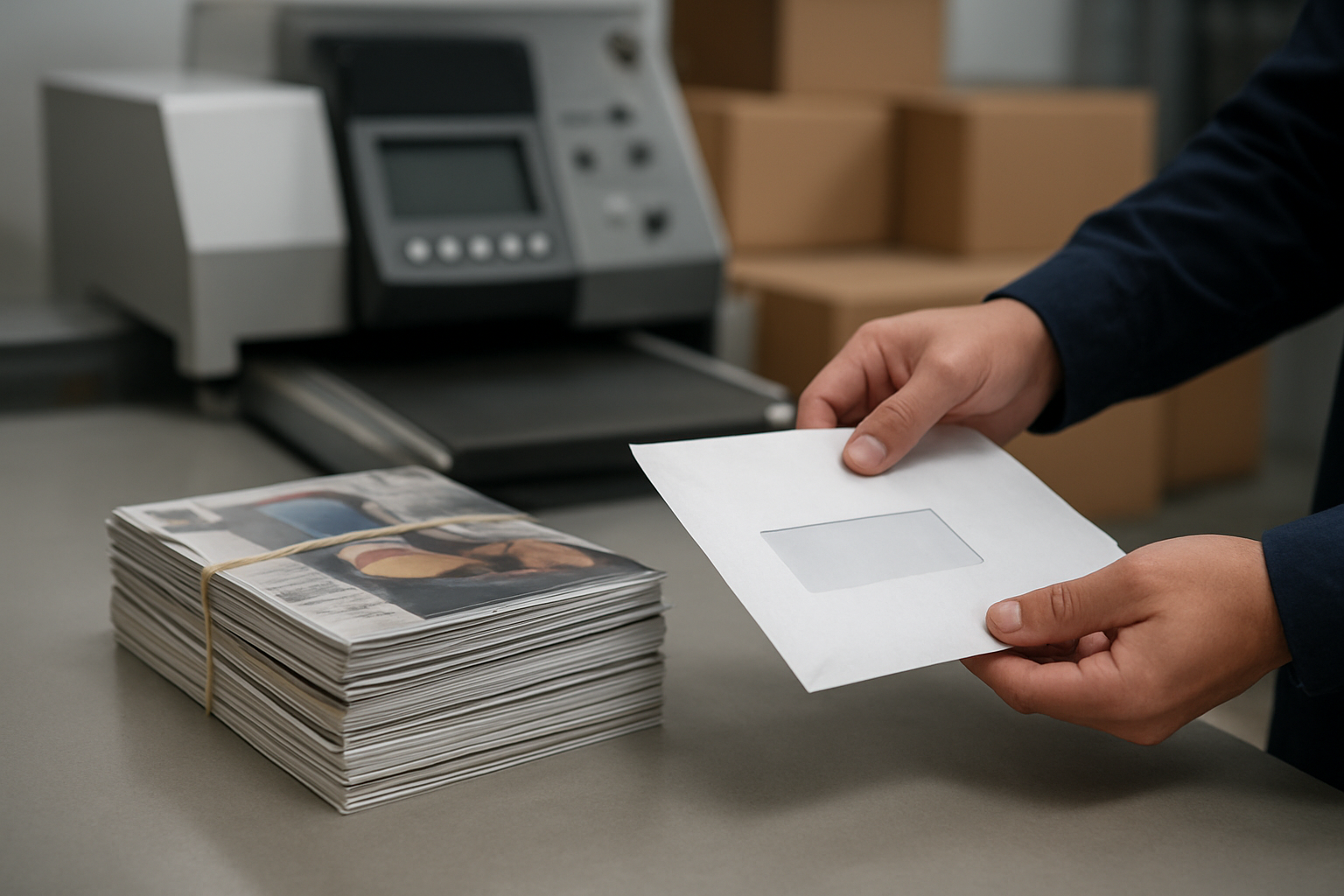
Fulfilment is where a beautiful print job becomes a reliable mailpiece. Your chosen method must protect the magazine, display the address clearly, and satisfy machine-processing standards in postal networks. Equally, it should complement your brand and environmental stance. Cliffe Enterprise Limited offers poly wrap, paper wrapping, and envelope enclosing at scale, and our postal-compliant workflows ensure clear zones, PPI (Postage Paid Impression) placement, and address legibility. Royal Mail Marketreach research has shown that addressed mail is often kept in the home for multiple days, so durability and presentation influence how long your content remains in sight and in use.
| Method | Brand Impact | Speed | Sustainability Perception | Notes |
|---|---|---|---|---|
| Poly wrap | Shows cover through, maximises visual tease | Fast on high-speed lines | Improving with recyclable films, but perception varies | Robust for wet weather delivery |
| Paper wrap | Print messaging on the outer, premium feel | Fast and scalable with modern kit | Strong sustainability perception | Protects covers from scuffing, printable for offers |
| Envelope enclosing | Formal and discreet | Moderate throughput | Widely recyclable | Windows require precise address positioning |
Postal compliance is precise. Maintain machine-readable clear zones, supply address blocks in a standardised format, and allow room for barcodes where required. If your campaign uses a carrier sheet, align text size and contrast for scanning. Request a sample pack from your provider to see examples of fully compliant windows, Mailmark placements, and PPI (Postage Paid Impression) layouts. Cliffe Enterprise Limited’s quality control includes test scans prior to live runs, ensuring your mailpieces pass mechanisation checks and progress swiftly through the network.
Postage Strategy: United Kingdom and Overseas Optimisation
Postage is often the largest single cost after print, so structure your specification to minimise weight, maximise machine readability, and harness the right service for your audience. For domestic United Kingdom delivery, Publishing Mail with Mailmark barcoding frequently offers an efficient balance of price and speed for subscription magazines. Sorting and barcoding improve traceability and may qualify for more favourable tariffs than non-barcoded streams. The most valuable tactic is weight control: a few grams saved per copy can prevent a higher band and yield substantial total savings across large quantities without compromising the reader experience.
For cross-border delivery, segment Europe from the rest of world and identify any time-sensitive territories. Cliffe Enterprise Limited’s IOS (International Operational Solution) was developed for consumer titles entering European Union markets, routing magazines via optimised consolidation and injection points. This approach can smooth customs interactions, stabilise transit times, and in many cases improve landed cost predictability. For North America and Asia-Pacific, a blend of priority and economy services may be appropriate based on subscriber expectations and renewal cycles. Provide your country splits in advance so service modelling can be performed quickly and accurately.
| Decision Area | What To Provide | Why It Matters | Optimisation Angle |
|---|---|---|---|
| Weight per copy | Estimated grams including wrap | Determines postage band | Fine-tune paper weights to stay below a band threshold |
| Address quality | Clean data with PAF (Postcode Address File) validation | Reduces returns and delays | Use suppression and deduplication to cut wastage |
| Service level | Target delivery window by market | Balances speed and price | Mix economy and priority services by subscriber tier |
| International routing | Country list and volumes | Enables consolidations | Leverage IOS (International Operational Solution) for European Union delivery |
Prepress, Proofing, and Production Timelines
Prepress readiness influences quality and schedule more than any other single factor. Supply Portable Document Format (PDF) files with trim marks, 3 millimetre bleeds, and all fonts embedded. Convert images to CMYK (cyan, magenta, yellow, key black) and use a suitable ICC (International Color Consortium) profile for your chosen stock and press. Maintain image resolution near 300 dots per inch for sharp reproduction. For barcodes such as ISSN (International Standard Serial Number) or EAN (European Article Number), request verification to avoid scanning failures. If brand-critical colours are involved, consider a calibrated digital proof or, for highly exacting work, a press proof on the intended stock.
When planning timelines, map key handoffs: editorial sign-off, artwork delivery, proof approval, print start, finishing, wrapping, and handover to the carrier. Typical lead times range from a few days for short saddle-stitched jobs to longer for perfect bound issues with special finishes. Allow extra contingency during peak seasons when paper mills, presses, and mail centres run at capacity. Ask your supplier to document service levels and escalation contacts in a simple SLA (service level agreement), with tracked milestones and status updates. Cliffe Enterprise Limited provides a dedicated project manager, giving you a single accountable partner from file receipt through confirmed delivery scans.
Quote-Ready Checklist, Examples, and Benchmark Data

Use this checklist to brief suppliers consistently, speed up pricing, and reduce to-and-fro. It tracks the nine essentials while highlighting where budgets move most. According to United Kingdom industry experience, paper selection, fulfilment method, and postage route typically account for the majority of variance between quotes. Meanwhile, clean data and postal compliance drive superior deliverability and fewer costly returns. Ready to test your next concept? Consider piloting with a smaller segment first, then scaling once real-world weights, mail centre scans, and subscriber feedback are known.
| Specification | Example Entry | Impact on Cost or Risk | Expert Tip |
|---|---|---|---|
| Quantity and schedule | 25,000 copies, monthly, files by 12:00 on the 10th | Determines press allocation and price breaks | Share a rolling three-edition plan to secure capacity |
| Trim size and binding | 210 x 297 millimetres, perfect bound | Affects paper usage and finishing time | Consider a slightly smaller format to reduce weight |
| Page count and cover | 84 pages plus 4-page cover, silk text, gloss cover | Drives signatures, spine, and postage weight | Align flatplan to efficient sectioning for fewer make-readies |
| Papers | 80 gsm silk text, 200 gsm gloss cover | Largest print cost driver and key for weight | Test 80 gsm versus 90 gsm for weight-band control |
| Colour and files | Full CMYK (cyan, magenta, yellow, key black), Portable Document Format with 3 mm bleeds | Impacts prepress time and print consistency | Use a single ICC (International Color Consortium) profile across pages |
| Finishing | Soft-touch laminate on cover, spot UV (ultraviolet) logo | Enhances premium feel, adds drying time | Confirm lamination compatibility with postal handling |
| Fulfilment method | Paper wrap with printed teaser copy | Alters sustainability perception and address area | Reserve adequate clear zones for PPI (Postage Paid Impression) |
| Address data | Comma-separated values with PAF (Postcode Address File) checks | Reduces returns and delays | Add seeds and agreed test addresses for each edition |
| Postage plan | United Kingdom Publishing Mail, European Union via IOS (International Operational Solution) | Dictates speed and landed cost | Share country splits to unlock consolidations |
Consider this real-world scenario. A consumer publisher sought to improve delivery speed without inflating budget. By right-sizing paper on the interior, switching from poly to paper wrap, and adopting Publishing Mail with Mailmark barcoding, they remained below a critical weight band and improved machine readability. Combined with address hygiene and country-level routing, the campaign achieved faster average delivery while trimming overall costs. Cliffe Enterprise Limited supplied consultation, sampling, and a clear production calendar so the editorial team could finalise artwork confidently. Similar results are common when specifications are aligned early and measured against both budget and audience outcomes.
How Cliffe Enterprise Limited Lowers Risk and Total Cost
Cliffe Enterprise Limited has operated since 1991 as a full-service magazine partner, uniting print, mailing fulfilment, postage optimisation, and worldwide distribution under one roof. Our magazine printing (quality, cost-effective production) spans short runs through bulk orders, with rigorous postal compliance embedded at each stage. We support paper wrapping, poly wrap, and envelope enclosing, all calibrated to Royal Mail mechanisation standards and address clear zones. Our team manages address validation, Mailmark barcoding, and returns so your subscriber data continually improves.
For international distribution, we combine competitive rates with practical routing, including our IOS (International Operational Solution) tailored to consumer titles entering European Union markets. Whether you are a publisher, a business mailing at volume, or a marketing agency coordinating complex campaigns, you receive quoting and consultation that surfaces trade-offs clearly. The outcome is predictable spending, improved deliverability, and on-time mail-outs—supported by proactive communication from a dedicated point of contact. If you want a partner who balances craftsmanship with logistics, Cliffe Enterprise Limited is built to deliver.
Expert tips to finalise your brief:
- Ask for a weight mock-up including wrap to confirm postage banding before sign-off.
- Request a single-page summary proof for the address block to validate clear zones and barcode placement.
- Provide your country split and returns policy for accurate international routing and cost control.
- State whether you require storage, staged mailings, or additional cartons for events or retail seeding.
Now, when colleagues ask what do i need for a magazine printing and mailing quote, you can supply a precise, production-ready checklist that speeds pricing and improves campaign performance.
Forward Momentum: From Specification to Delivery
Getting your specification right is the fastest route to accurate pricing, resilient schedules, and better reader experience. Everything flows from the nine essentials you now hold. Imagine eliminating last-minute scrambles because paper weights, clear zones, and country splits are all validated—and your budget benefits from optimised print and postage choices. In the next 12 months, teams that operationalise this approach will build repeatable processes that consistently deliver on time and on cost.
So, when your team asks what do i need for a magazine printing and mailing quote, will you be equipped with a crisp, data-driven brief that reduces risk and elevates quality?
Elevate Magazine Printing Quotes with Cliffe Enterprise Limited
Accelerate results for publishers, bulk mailers, and agencies through magazine printing (quality, cost-effective production) that cuts spend, speeds mail-outs, and expands global reach.