

You are likely balancing sustainability imperatives, postal rules, and budget pressures, which is why interest in polywrap alternatives paper wrap has surged among publishers. Environmental scrutiny has accelerated, boards have set measurable targets, and readers notice the difference at the letterbox. At the same time, Royal Mail (United Kingdom Postal Service) format thresholds and machinability standards still determine whether a mailing is viable at scale. In this guide, you will find clear, data-informed guidance on lower-plastic and plastic-free routes, along with cost, compliance, and brand considerations tailored to UK (United Kingdom) magazine mailing.
Cliffe Enterprise Limited has supported magazine printing and distribution since 1991, operating end-to-end across printing, Mailing fulfilment services (poly wrap, paper wrapping, envelope enclosing), postage optimisation, and worldwide distribution. Drawing on thousands of projects from small test runs to bulk orders, the team advises on packaging selection, weight engineering, address presentation, and overseas entry strategies. The goal is straightforward: meet postal requirements, reduce postage costs, protect deliverability, and maintain a high-impact reader experience. What does the optimal blend look like for your schedule, your format, and your budget?
Why the Shift from Polywrap Is Accelerating in the UK (United Kingdom)
Publisher decisions are increasingly shaped by three forces: consumer sentiment, regulatory momentum, and postal economics. Surveys frequently report that a significant majority of British consumers aim to cut single-use plastics, while industry analyses put global plastic recycling rates in the single digits. In parallel, corporate disclosure expectations are tightening, and packaging choices appear in Environmental, Social, and Governance (ESG) dashboards. These pressures translate to procurement briefs that prioritise fibre-based solutions, visibly recyclable materials, and clean-label messaging. The result is a market-wide pivot toward paper wrapping, paper envelopes, and other fibre-first designs that still protect contents and perform in sorting machinery.
Postal performance is the second lever, and it carries real money. Royal Mail (United Kingdom Postal Service) price bands depend on weight, dimensions, and machinability, so the grams you add or subtract by changing a wrapper can swing your item between formats. Paper wraps typically weigh more than LDPE (Low-Density Polyethylene) films yet provide a printable, brandable canvas that can eliminate separate carrier sheets. When engineered correctly, paper‑based packs can stay within Large Letter thresholds, maintain Optical Character Recognition (OCR) address readability, and flow through automated processing. With the right specification, sustainability and savings are not at odds, they are complementary.
Polywrap Alternatives Paper Wrap: Seven Postal-Smart Options
There is no single best answer for every title; the right substitute depends on pagination, frequency, inserts, data rules, and service levels. Below are seven viable options for UK (United Kingdom) magazine mailing, each proven at scale when specified and produced correctly. Consider them as a toolbox rather than a binary choice, and test against your own weight ladders, Royal Mail (United Kingdom Postal Service) service, and marketing objectives. Where relevant, Cliffe Enterprise Limited can prototype on live machinery and model postage impact before you commit spend.
- Paper wrapping: Modern paper wrap systems apply an on-machine, fully printable paper web around the magazine, sealing with hot-melt adhesives and inkjetting addresses directly. You gain a premium tactile finish, space for promotions, and a visibly recyclable message that aligns with Forest Stewardship Council (FSC) sourcing. While paper adds grams versus film, specification controls such as lighter basis weights and tighter trim can keep most 48–96-page titles within Large Letter. It is a strong default for publishers seeking a cleaner environmental story without compromising throughput.
- Envelope enclosing: Using C4 (International Organization for Standardization envelope size C4) or C5 (International Organization for Standardization envelope size C5) envelopes offers a tidy, letter-like presentation that readers recognise and trust. Windowless, white paper with a clear return address and Printed Postage Impression (PPI) often improves compliance and reduces scuffing on high-ink covers. This format handles multiple inserts well and can carry tactical messages on the envelope itself. The trade-off is weight and the envelope’s thicker profile, so pre-tests are advised to maintain target bands.
- Belly-banded “naked” mail: A recyclable paper band holds the magazine closed and provides a carrier area for addressing and barcodes. When paired with cover spot varnish to resist transit abrasion, this solution reduces packaging material to a minimum. It works best for robust covers and moderate page counts, and it can deliver the lowest material footprint. Careful address placement, two or three wafer seals, and a return address line keep Royal Mail (United Kingdom Postal Service) happy.
- Glassine or translucent paper enclosures: Glassine is a smooth, translucent paper that protects while allowing cover art to show through, which can be valuable for consumer titles. It is fully paper-based, curbside recyclable in many areas, and printable for addressing. Weight is similar to light envelopes but often lower than opaque kraft, so it can be a sweet spot for aesthetic-led brands. Moisture resistance is good, though not equivalent to film, so weatherproofing considerations should be discussed for winter mailings.
- Home-compostable biofilm: Where a film format remains operationally preferred, home-compostable materials such as PLA (Polylactic Acid) offer a plastic-light pathway. These wraps perform like traditional film in speed and clarity while aligning with visible sustainability goals. They typically carry certification logos that are meaningful to subscribers, though end-of-life processing depends on local systems. Because films are lighter than paper, this route can prevent weight band jumps on heavy titles.
- Recycled LDPE (Low-Density Polyethylene) as a transitional step: For some publishers, an interim solution using high-recycled-content LDPE stabilises costs and preserves machinability while long-term paper conversions are tested. Clear communication on recycled content and recycling instructions can mitigate reputational risks. This path also allows orderly de-risking, with real data on address readability and returns before committing to full paper. It is not plastic-free, but it can be part of a staged roadmap.
- Board-backed or rigid paper mailers: When pristine condition is paramount, rigid paper mailers or board-backed envelopes protect corners and spines. These are ideal for high-value issues, annuals, or coffee-table editions, and they present a premium unboxing moment. They are heavier, so they suit lower-volume special sends or segmented VIP lists. Use sparingly for protection-critical cohorts rather than as your everyday workhorse.
| Option | Weight vs LDPE (Low-Density Polyethylene) | Machinability | Branding Surface | Recyclability | Typical Use Case |
|---|---|---|---|---|---|
| Paper wrapping | +5 to +20 g depending on spec | High with correct adhesion and trim | Excellent, full-coverage print | Widely recyclable | Main run consumer and trade titles |
| Envelope enclosing | +10 to +30 g | High; watch thickness | Good, both sides | Widely recyclable | Multi-insert campaigns, membership mailings |
| Belly band self-mailer | −5 to +5 g | Moderate; sealing critical | Limited but impactful | Widely recyclable | Lightweight titles, eco-led brands |
| Glassine enclosure | +10 to +20 g | High when sealed properly | Moderate, translucent | Widely recyclable | Design-forward magazines |
| Home-compostable biofilm | −10 to 0 g | Very high | Carrier sheet or insert branding | Compostable where supported | Weight-sensitive runs |
| Recycled LDPE (Low-Density Polyethylene) | Baseline | Very high | Carrier sheet branding | Recyclable at collection points | Transitional strategy |
| Rigid paper mailers | +20 to +60 g | Moderate; often non-machinable | Good, premium feel | Widely recyclable | Special editions, VIP cohorts |
Postal Compliance and Cost: What Changes When You Switch?
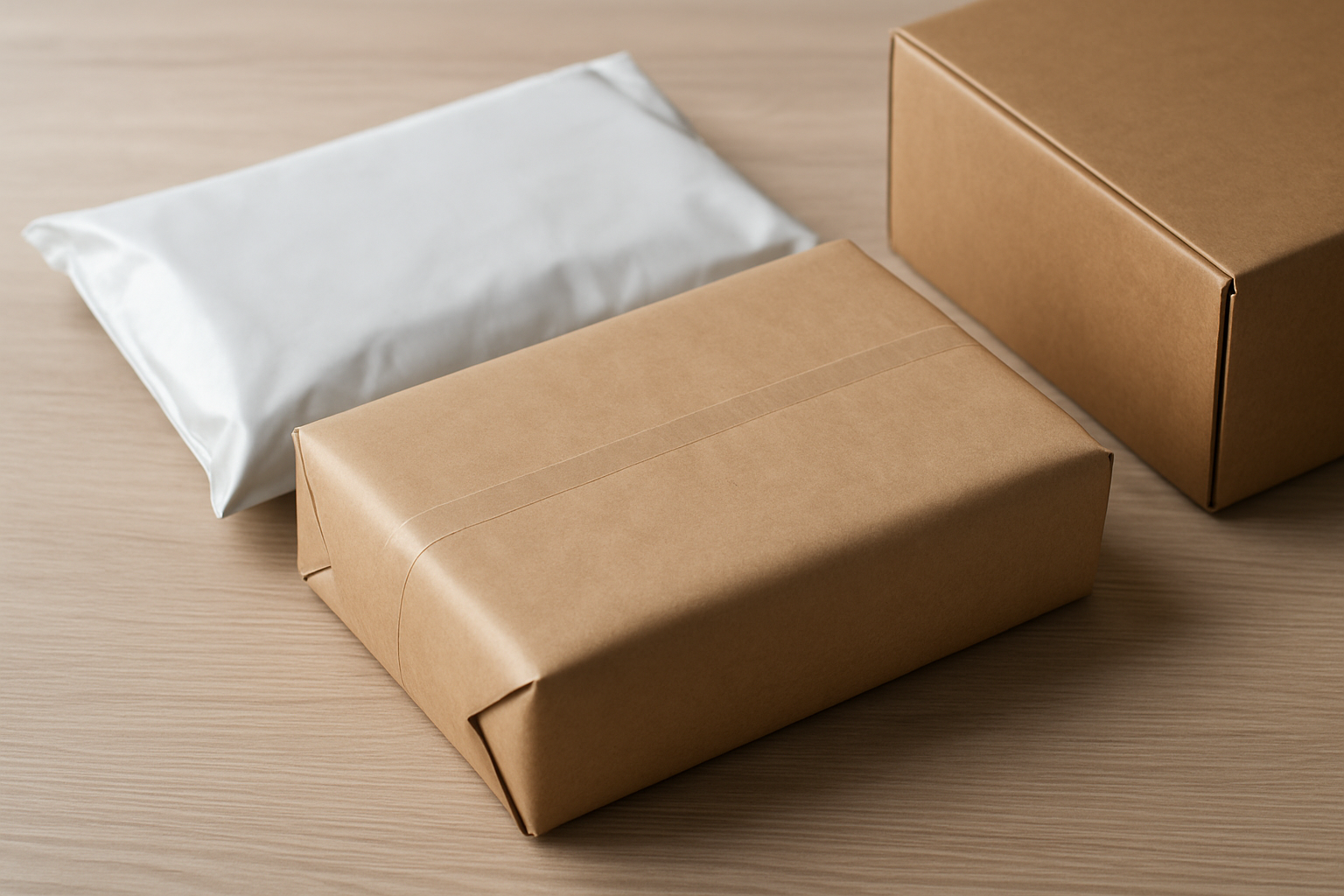
Any change of wrapper should be assessed against Royal Mail (United Kingdom Postal Service) format bands, thickness, machinability, and address readability. Large Letter tolerances are tight, so a millimetre here and a gram there matter. Address blocks must remain in the preferred clear zone, font and contrast must pass Optical Character Recognition (OCR) checks, and full return addressing safeguards undeliverables. When moving from film to paper, consider ink absorbency, drying time for inkjet addressing, and seal integrity under conveyor stress. Spec refinements mitigate risk: choose a paper basis weight that hits your target mass, set adhesive width to prevent open edges, and align flap positions to machine grippers.
| Royal Mail (United Kingdom Postal Service) Format | Max Weight | Max Thickness | Machinability Considerations | Typical Packaging to Hit Band |
|---|---|---|---|---|
| Letter | 100 g | 5 mm | Perfect edges, rigid enough to scan | Light belly band or thin film |
| Large Letter | 750 g | 25 mm | Even thickness, sealed edges, readable address zone | Paper wrap, glassine, envelopes (C5/C4) |
| Small Parcel | 2 kg | Varies | Generally non-machinable, manual handling | Rigid mailers, board-backed packs |
To control cost when switching to paper, engineers focus on grams and airflow. Techniques include moving to a lighter internal text stock, trimming oversize covers, and consolidating small inserts into a single stitched tip-on. Sealing methods matter too; narrower glue lines and accurate fold tolerances reduce rework and spoilage, protecting postage eligibility. Finally, data preparation influences price by qualifying you for better tariffs, so ensure deduplication, correct PAF (Postcode Address File) validation, and Mailmark barcode placement are configured by your mailing house partner. Cliffe Enterprise Limited hardens this process with pre-flight checks and live test packs before any full-scale deployment.
Operational Implications: Data, Machinery, and Lead Times
Packaging changes ripple through production calendars, so a structured transition plan is essential. Paper wrapping may require different feeder configurations, adhesive patterns, and inkjet settings than poly lines, and envelope enclosing has its own cycle times. In addition, paper substrates need distinct drying curves to ensure scuff resistance and addressing clarity. Each of these considerations affects lead time and capacity, especially in peak seasons, which is why pilot runs and time studies should precede large-scale changes. With robust Standard Operating Procedures (SOPs), variance drops and on-time dispatch improves.
Data governance underpins deliverability and pricing. General Data Protection Regulation (GDPR) standards require lawful processing, and data hygiene directly affects waste and returns. Implement address deduplication, suppress deceased/relocated recipients, and align salutations to your brand voice. Operationally, Cliffe Enterprise Limited integrates data checks with artwork pre-flighting, ensuring the address block and PPI (Printed Postage Impression) stay legible on paper substrates. The company’s Mailing fulfilment services (poly wrap, paper wrapping, envelope enclosing) operate on compatible lines, allowing you to run A/B tests across packaging types within the same production window. This reduces risk and provides real-world evidence for the best-performing format.
- Run a 5 to 10 percent pilot to confirm machinability and returns.
- Model postage with real weights and dimensions rather than catalogue assumptions.
- Pre-clear creative with address clear zone and contrast checks for OCR (Optical Character Recognition).
- Confirm adhesives, flaps, and trims with live pack samples.
- Book capacity early for peaks and international dispatch cutoffs.
Case Studies and Scenarios: Savings, Brand Lift, and Risk Management
Consider an illustrative consumer monthly at 68 pages, a glossy cover, and one insert. In film, it sits at 235 g as a Large Letter. Switching to paper wrap adds 12 g, still within the same band, while unlocking full-coverage print for subscription offers that would have required a carrier sheet in film. Over a year, the team can rotate creative on the wrap, promote sampling partners, and present clear recycling cues. Returns remain stable after address zone and ink-drying optimisations, and response tracks slightly higher, attributed to the more premium unwrapping experience.
Now imagine a membership title with frequent multi-insert packs. Envelope enclosing consolidates components and minimises handling loss, though weight moves 18 g higher. Because data is exceptionally clean and Mailsort trays are well prepared, the final price remains on budget. For a limited seasonal special, a board-backed mailer protects corner integrity and reduces damage claims at the expense of weight, reserved for a VIP segment. Each choice is defensible when framed against audience value, postal bands, and physical risk, and a matrix helps stakeholders see trade-offs quickly.
| Scenario | Chosen Option | Weight Change | Postal Band Impact | Primary Benefit | Risk Mitigated |
|---|---|---|---|---|---|
| Consumer monthly, 68pp + insert | Paper wrapping | +12 g | No change | Brandable wrap, recyclable message | Address clarity via ink settings |
| Membership pack, multiple inserts | Envelope enclosing | +18 g | No change | Component control, tidy presentation | Insert loss prevention |
| Design-led bi-monthly, light pagination | Glassine enclosure | +15 g | No change | Cover visibility with paper solution | Moisture scuffing |
| High-weight quarterly | Home-compostable biofilm | −8 g | No change | Weight-sensitive savings | Machinability assurance |
| Special edition VIP send | Rigid paper mailer | +45 g | Band up | Pristine delivery | Corner damage |
Partnering With Cliffe Enterprise Limited: From Trial to Global Rollout
Changing packaging is not just a materials decision; it is a workflow upgrade spanning data, pre-press, production, and postal entry. Cliffe Enterprise Limited provides integrated magazine printing, Mailing fulfilment services (poly wrap, paper wrapping, envelope enclosing), and postal compliance checks to ensure your test plans translate into dependable schedules. Postal expertise covers UK (United Kingdom) and overseas options with competitive rates and appropriate documentation, including an IOS (Import One-Stop Shop) solution for distributing consumer titles into Europe (European Union). This unified model minimises handoffs and errors, while quoting and consultation help you see the full cost-to-serve picture before you commit.
The company’s approach is pragmatic and evidence-led. First, align objectives and constraints in a discovery call. Next, run a controlled pilot on the selected packaging route, validating OCR (Optical Character Recognition), seal strength, and weights. Then, scale to full production with service levels matched to your on-sale dates. For international growth, engage the IOS (Import One-Stop Shop) solution to streamline European (European Union) delivery and reduce friction on duties, while the worldwide distribution network covers everything from small batches to bulk consignments. Throughout, you gain a single accountable partner focused on accuracy, deliverability, and cost control.
- Magazine printing with quality control and cost-effective production.
- Mailing fulfilment services (poly wrap, paper wrapping, envelope enclosing) across compatible high-speed lines.
- Postal compliance and mail-out accuracy aligned to Royal Mail (United Kingdom Postal Service) requirements.
- UK (United Kingdom) and overseas postage expertise with competitive rates.
- IOS (Import One-Stop Shop) solution for European (European Union) distribution of consumer titles.
- Worldwide magazine distribution from small to bulk orders.
- Quoting and consultation to tailor solutions to your needs.
Making the Decision: A Practical Selection Framework
To finalise your pathway, rank options against measurable criteria: weight impact relative to target band, machinability probability, recyclability optics, brand surface area, and unit cost. Assign each a simple score and apply weights based on your strategy, for example prioritising environmental messaging for consumer titles or operations speed for trade journals. Engage your fulfilment partner early to validate address readability and sealing under real load, and secure paper grades ahead of peak to de-risk supply. A well-governed test-and-learn cycle will outperform assumptions every time, and it equips you to present a confident business case to finance and leadership teams.
When you compare the seven routes side by side, patterns emerge. Paper wrapping tends to win for balance and branding; envelope enclosing excels in component control; glassine serves design-led blends; belly bands delight eco-minded audiences; biofilm protects weight-sensitive economics; recycled LDPE (Low-Density Polyethylene) gives a measured transition; and rigid mailers preserve premium editions. With the right partner, you can deploy more than one route across your portfolio, matching format to audience value and geography. That is how packaging becomes a strategic lever rather than a commodity choice.
Core takeaway: the format you choose shapes costs, compliance, and reader experience, so model it, test it, and then scale it with discipline.
Imagine your next 12 months: a cleaner pack on the doormat, fewer returns, calmer pre-press, and happier subscribers opening a premium-feel package. What would adopting polywrap alternatives paper wrap and its sister options unlock for your team’s schedule, budget, and brand narrative?
Advance Polywrap Alternatives with Cliffe Enterprise Limited
Cliffe Enterprise Limited streamlines magazine distribution with Mailing fulfilment services (poly wrap, paper wrapping, envelope enclosing), reducing postage costs and improving deliverability for publishers, bulk mailers, and marketing teams.