

The Polywrap Magazine Mailing Playbook: 8 Proven Ways UK Publishers Cut Postage & Boost Deliverability
Polywrap magazine mailing is the quiet performer behind stable circulation costs and resilient delivery performance. If your audience is in the UK (United Kingdom), tiny adjustments in wrap specification, address data, sortation, and routing can unlock outsized savings while protecting reader experience. Publishers tell us they want fewer returns, faster in-home delivery, and reliable postage budgets even as paper and fuel fluctuate. Cliffe Enterprise Limited has helped many publishers achieve that balance, combining high-quality, cost-effective magazine printing with postal-compliant mailing fulfilment across domestic and international lanes.
This playbook distils eight proven techniques that United Kingdom publishers, marketing agencies, and volume print buyers repeatedly use to cut postage and raise deliverability. You will see how weight engineering works in practice, what to change in your wrapping line, and why small prepress and data decisions are often the biggest levers. Along the way, we will reference pragmatic tools, indicative benchmarks, and real-world examples so you can copy what works and avoid avoidable rework.
Fundamentals of Polywrap Magazine Mailing
At its core, polywrap mailing encloses a magazine and any inserts within a clear polythene film, addresses the pack, and prepares it for automated sortation. Compared with paper wrap and traditional envelopes, polywrap preserves visibility of the cover, reduces pack weight, and tolerates heavier enclosures at scale. It is distinct from shrink wrapping, which uses heat to tighten film for transit bundling rather than high-volume, machine-readable direct mail. Why has polywrap become the go-to for publishers with supplements, onserts, or seasonal guides? Because grams matter, machine-readability matters, and the right wrap keeps both in your favour.
| Method | Material weight impact | Address visibility | Insertion flexibility | Typical unit materials cost | Environmental note | Best fit |
|---|---|---|---|---|---|---|
| Polywrap (polythene film) | Lowest added grams | Excellent, front cover visible | High, supports onserts and multiple inserts | Low to medium | Recyclable where facilities exist; compostable/biodegradable alternatives available | Cost control, heavier packs, high-speed runs |
| Paper wrap | Higher added grams versus film | Printed carrier replaces visible cover | Moderate, thickness rises with contents | Medium | Strong sustainability perception; curbside recycling depends on local schemes | Eco-led campaigns where weight bands are tolerant |
| Envelope enclosing | Highest added grams | Limited, cover hidden | Moderate, dependent on envelope size | Medium to high | Widely recyclable paper, plastic windows vary | Premium letters, smaller formats |
Postal compliance underpins every packaging decision. Royal Mail (United Kingdom Postal Service) machinability standards define acceptable dimensions, thickness, address clear zones, and barcode locations, and these determine which price tiers you can access. Weight bands and sortation level further shape cost, so a 10 gram shift can move a pack into a lower band and save several pence per copy across a full mailing. Data integrity is equally critical. Validating addresses against PAF (Postal Address File), removing duplicates, and suppressing gone-aways reduce return rates and prevent surcharges that erode savings.
Finally, sustainability is best treated as a design input, not an afterthought. Compostable or biodegradable wrap alternatives, clearer recycling labelling aligned with OPRL (On-Pack Recycling Label) guidance, and measured comparisons to paper wrap help you retain cost control without undermining your environmental story. In many scenarios, the lowest-carbon option is the pack that travels once to the correct recipient. Clean data and machine-compliant packs therefore support both your budget and your ESG narrative.
How Polywrap Magazine Mailing Works
The operational flow is a precise sequence that marries data, materials, and postal engineering. When configured correctly, it scales effortlessly for both small runs and large bulk orders. Cliffe Enterprise Limited operates high-speed lines capable of releasing well over 300,000 packs per day, but the same best practices apply to a 2,000-copy niche journal. Below is the flow that repeatedly produces lower costs and higher first-time delivery.
- Data preparation: cleanse subscriber files against PAF (Postal Address File), apply gone-away and deceased suppressions, and standardise fields in line with GDPR (General Data Protection Regulation) and PECR (Privacy and Electronic Communications Regulations).
- Versioning and inserts: define segments, regional editions, and selective inserts to manage weight and relevance. Use a matrix to keep each version inside target weight bands.
- Personalisation and addressing: generate Mailmark-compliant artwork for carrier sheets or print addresses directly to film where specified. Maintain clear zones and contrast for camera read rates.
- Wrap specification: choose film specification appropriate to pack weight and machinability; consider compostable or biodegradable alternatives. Add anti-static where needed for consistent feed.
- Mechanical insertion: feed the magazine and inserts, onsert cards or samples, and any covermounts through synchronised hoppers to protect collation accuracy at speed.
- Sortation and containerisation: presort to Royal Mail (United Kingdom Postal Service) or DSA (Downstream Access) requirements, generate bag labels, and manifest electronically for traceability.
- Despatch and tracking: trunk to entry points, capture handover scans, and monitor performance against SLA (Service Level Agreement) with carrier dashboards and internal KPI (Key Performance Indicator) reports.
Best Practices: 8 Proven Ways to Cut Postage and Boost Deliverability with Polywrap Magazine Mailing
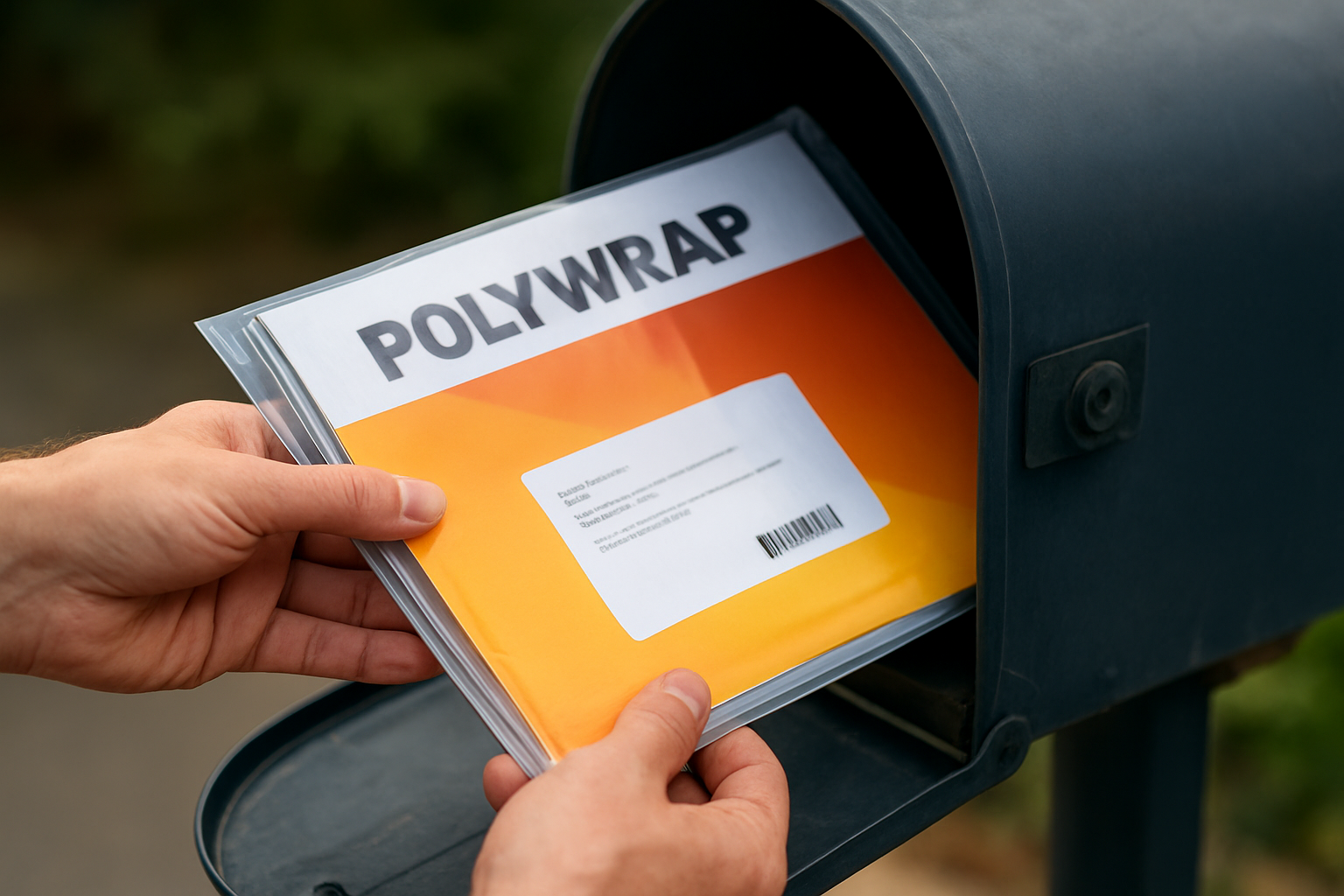
Across many magazine mailings, a consistent set of techniques drives predictable savings and measurably better delivery. These eight levers can be implemented singly, but the strongest results come from combining weight engineering, smarter sortation, and data quality. Indicative saving ranges reflect typical outcomes observed in United Kingdom periodical mail, although your audience profile, formats, and volumes will influence the exact result.
- Engineer for a lower weight band: reduce wrap thickness, trim a few editorial pages, or re-spec inserts to drop 5–10 grams. Publishers commonly see 6–18 percent postage reduction from a single band shift, validated via Royal Mail (United Kingdom Postal Service) rate tables. Cliffe Enterprise Limited models this in prepress to confirm impact before you commit.
- Adopt Mailmark and deeper presort: Mailmark-ready addressing with machine-optimized presort typically unlocks 3–8 percent savings and stronger tracking. It also improves read rates at the mail centre, which supports faster in-home delivery for time-sensitive issues.
- Use selective insertion to control pack variability: send heavier supplements only to engaged segments and keep the base pack lean. This increases relevance and preserves weight discipline without compromising perceived value.
- Right-size dimensions for machinability: confirm final thickness, flexibility, and aspect ratio to remain within preferred machine parameters. Avoiding an oversize threshold can be worth more than any print discount buried in the unit rate.
- Cleanse and enrich addresses rigorously: PAF (Postal Address File) validation, deduplication, and suppression of movers routinely cuts returns by 20–40 percent. Better data reduces wasted postage and improves first-time delivery, enhancing subscription retention.
- Consolidate volumes through comailing: when appropriate, co-mingle compatible titles to reach better sortation tiers with DSA (Downstream Access) carriers. Savings of 4–12 percent are achievable, and Cliffe Enterprise Limited manages multi-title consolidation while maintaining title-level reporting.
- Choose a film or wrap material that meets your sustainability and machinability requirements: properly specified, lower-impact or compostable alternatives can meet your sustainability needs without sacrificing grams. Ensure camera readability and seal integrity at speed to prevent mis-sorts and rewraps.
- Optimise international routes and duties: for European subscribers, use IOSS (Import One-Stop Shop) where applicable and consider Cliffe Enterprise Limited’s IOS (International Outbound Solution) for distributing consumer titles into Europe. Expect faster customs clearance and reduced undeliverables, which increases effective reach.
| Tactic | Indicative postage saving | Deliverability impact | Complexity | Notes |
|---|---|---|---|---|
| Weight band engineering | 6–18 percent | Neutral to positive | Medium | Test alternate papers and film thicknesses before print |
| Mailmark and presort | 3–8 percent | Positive via tracking and machine-readability | Low | Requires compliant addressing and barcoding |
| Selective insertion | 2–7 percent | Positive through relevance | Medium | Use clear segment rules to avoid errors |
| Dimensional right-sizing | 2–5 percent | Positive, fewer mis-sorts | Low | Confirm machinability envelopes in advance |
| Address hygiene | Postage waste down 20–40 percent | Strongly positive | Low | Apply PAF (Postal Address File) and suppression monthly |
| Comailing via DSA (Downstream Access) | 4–12 percent | Neutral to positive | Medium | Maintains title-level traceability |
| Lower-impact film/wrap options | Cost neutral to slight saving | Positive when specified correctly | Low | Check camera contrast and seal strength |
| International routing with IOSS (Import One-Stop Shop) and IOS (International Outbound Solution) | Variable, fewer customs holds | Strongly positive | Medium | Reduce returns and transit time for European deliveries |
Two brief examples illustrate the compounding effect. A monthly consumer title at 80,000 copies trimmed 8 pages, dropped to a lighter film, and moved to deeper presort, achieving a 14 percent postage reduction and a 5 percent improvement in first-time delivery. A B2B (business-to-business) quarterly at 22,000 copies applied strict PAF (Postal Address File) hygiene and selective insertion, cutting returns by 37 percent and removing two pallets of wasted postage per issue. Cliffe Enterprise Limited engineered both outcomes by modelling weight, pre-validating machinability, and supervising presort files end to end.
Common Mistakes That Inflate Cost and Hurt Delivery
Many avoidable errors creep in when production, data, and postal requirements are managed in silos. By recognising these patterns early, you can protect budget and brand reputation. The following pitfalls occur most often in new or complex campaigns and are all solvable with disciplined planning and an experienced fulfilment partner.
- Assuming film swaps are weight neutral: moving from a lighter film to a heavier film can erase a fragile weight-band saving. Always re-weigh full packs, not just components.
- Ignoring machine-read clear zones: artwork that crowds the address window or barcode can lower camera read rates and trigger manual handling charges.
- Unverified address data: skipping PAF (Postal Address File) validation or suppression increases returns, hurts deliverability, and risks compliance issues under GDPR (General Data Protection Regulation).
- Last-minute insert changes: adding a heavy insert without rechecking weight moves packs into higher postage tiers and disrupts presort plans.
- Under-declaring weight: inconsistent scales or rounding down invites surcharges and reputational damage with carriers.
- Overlooking seasonal capacity constraints: peak weeks require early booking of plant time and transport, otherwise deadlines slip and costs rise.
- Poor international documentation: missing HS codes or CN22 (Customs Declaration Form CN22) details can delay customs and inflate undeliverables for overseas copies.
- No returns process: failing to capture reason codes on returns means the same bad addresses stay on file and waste postage next issue.
Cliffe Enterprise Limited mitigates these risks through postal-compliant processes, scale-tested quality checks, and transparent reporting. Plant teams confirm machinability, data specialists certify address quality, and postal experts validate the despatch profile against Royal Mail (United Kingdom Postal Service) or DSA (Downstream Access) requirements before anything leaves the floor. This discipline keeps your promises to subscribers and advertisers alike.
Tools and Resources to Execute With Confidence

The right tools remove guesswork and allow you to make confident trade-offs. A simple weight model, a reliable address hygiene routine, and a postal planning calendar will prevent most surprises. When you need specialist advice, a partner with end-to-end capabilities can run alternate scenarios and return with an evidence-backed recommendation the same day.
- Weight and spine calculators: estimate the pack using paper grammage, page count, and film thickness to predict the final band with a margin for inserts.
- Address validation and suppression: schedule PAF (Postal Address File) cleansing, deduplication, and mover suppressions before each mailing cycle.
- Postal planning templates: align editorial sign-off, press dates, wrap windows, and handover to protect in-home targets for weekly, monthly, or quarterly titles.
- Carrier guidance: review Royal Mail (United Kingdom Postal Service) Mailmark technical manuals and product specifications before design freeze.
- Measurement: use JICMAIL (Joint Industry Committee for Mail) insights to benchmark attention and retention, then tie delivery performance to subscriber outcomes.
| Area | Action | Owner | Timing | Outcome |
|---|---|---|---|---|
| Weight modelling | Confirm pack spec and weigh live dummies | Production manager | 2 weeks pre-press | Target weight band confirmed |
| Data hygiene | PAF (Postal Address File) clean, suppress movers, dedupe | Data team | 7 days pre-wrap | Return rate reduced |
| Machinability | Validate dimensions, clear zones, barcode placement | Artwork and postal lead | At artwork sign-off | Fewer camera read failures |
| Presort plan | Choose Royal Mail (United Kingdom Postal Service) or DSA (Downstream Access) product, confirm trays and labels | Fulfilment partner | 3 days pre-wrap | Correct pricing applied |
| International | Apply IOSS (Import One-Stop Shop) where relevant, prepare CN22 (Customs Declaration Form CN22) | Postal specialist | 3 days pre-despatch | Fewer customs delays |
| Reporting | Define SLA (Service Level Agreement) and KPI (Key Performance Indicator) dashboards | Operations lead | Before handover | Performance visibility |
Cliffe Enterprise Limited brings all these components together as a full-service partner. The team provides quality, cost-effective magazine printing; poly wrap, paper wrapping, and envelope enclosing; postal compliance and mail-out accuracy; domestic and overseas postage optimisation with competitive rates; a unique IOS (International Outbound Solution) for distributing consumer titles into Europe; and worldwide distribution for small batches through bulk orders. If you need a fast sense check or a tailored quote, their consultants will model options, share benchmarks, and recommend a path that defends both budget and reader satisfaction.
Conclusion
Eight operational levers can cut postage and lift deliverability without compromising your brand or subscriber promise.
In the next 12 months, the winners will treat every gram, segment, and postcode as a decision lever, combining precise print with postal engineering. Imagine a mailing line where each issue is pre-validated for weight, machinability, and route, then delivered cleanly on the first attempt. Which of the proven tactics will you apply to your next polywrap magazine mailing?
Elevate Polywrap Mailing With Cliffe Enterprise Limited
Lower postage and improve delivery through magazine printing (quality, cost-effective production) integrated with expert fulfilment for publishers, agencies, and volume mailers.