
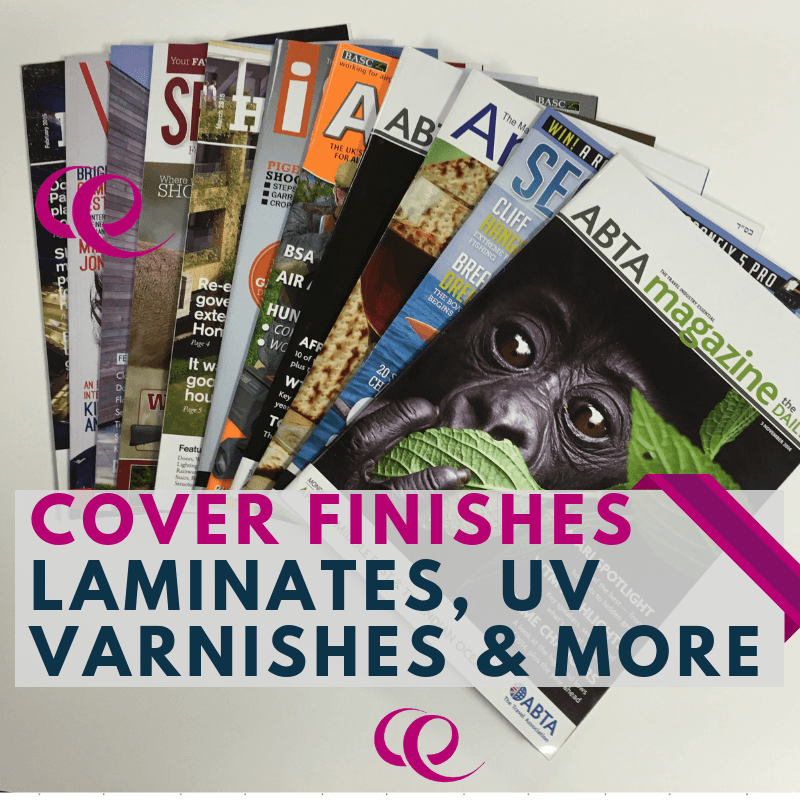
Magazine Cover Finishes Explained
The finish applied to a magazine cover can change its appearance, feel and durability.
Lamination, varnishes, foil and embossing can all be used to enhance a cover, but the right choice depends on the publication, cover material, printing process, design, quantity, handling requirements, budget and production schedule.
A specialist finish should have a purpose.
For some magazines, a simple printed cover on an appropriate paper is exactly right. For others, lamination can provide useful protection or a particular tactile quality. A carefully positioned foil, spot UV varnish or embossed element can make an important part of the design stand out.
At Magazine Printing Company, cover finishing is considered as part of the complete magazine specification rather than as an automatic add-on.
Does a Magazine Cover Need a Special Finish?
No.
A magazine does not automatically need lamination, varnish or another decorative finish.
The decision should depend upon what the cover needs to achieve.
Consider:
- the cover paper or board
- the visual design
- how the magazine will be handled
- whether it will be mailed
- the required durability
- the printing process
- the production quantity
- the publication frequency
- the available budget
- the production schedule
A finish that adds genuine value to a premium annual publication may be unnecessary for a frequently produced membership magazine.
The objective is to choose a finish appropriate to the publication rather than add processes simply because they are available.
What Is Magazine Cover Lamination?
Lamination applies a thin film to the printed surface of the cover.
It can change both the appearance and feel of the magazine while also providing additional surface protection.
Common options include:
Gloss lamination
Produces a shiny, reflective surface and can give imagery and colours a high-impact appearance.
Matt lamination
Produces a less reflective, more subdued surface and is widely used where a softer visual appearance is preferred.
Soft-touch lamination
Provides a distinctive tactile surface with a softer feel.
Other specialist films and finishes may also be available depending upon the production route.
The appropriate laminate should be selected according to the cover stock, printed design, subsequent finishing processes and intended use of the magazine.
What Is the Difference Between Matt and Gloss Lamination?
The principal difference is visual and tactile.
Gloss lamination reflects more light and can create a brighter, higher-contrast appearance.
Matt lamination produces a more restrained, low-reflection surface.
Neither is automatically better.
A photographic cover designed around vibrant imagery may suit gloss, while another publication may deliberately use matt to create a quieter or more tactile appearance.
Dark matt surfaces can also be more susceptible to showing handling marks or scuffing, depending upon the material and application.
Where that is a concern, the specification should be discussed before production rather than assuming all matt laminates perform identically.
What Is Soft-Touch Lamination?
Soft-touch lamination is selected primarily for its tactile quality.
It gives the cover a distinctive soft surface that can help a publication feel different when handled.
This can work particularly well for publications where the physical experience of the magazine forms an important part of the design.
However, it is a specialist finishing choice and normally carries an additional production cost.
Whether it is worthwhile depends upon the publication and what the cover is intended to communicate.
Does Lamination Protect a Magazine Cover?
It can provide useful additional surface protection.
Magazine covers may be handled during production, packing, mailing, distribution and reading. A laminated surface can help protect the printed cover from some rubbing, marking and handling.
That does not make a laminated cover indestructible.
The level of protection depends upon the laminate, cover stock, design and way the finished publication is handled.
For mailed magazines in particular, cover finishing should be considered alongside the wrapping or mailing method rather than in isolation.
What Is a Varnish?
A varnish is a coating applied to a printed surface.
Depending upon the process and specification, varnishes can be used for protection, appearance or decorative effect.
Some varnishes are applied across a complete surface, while others can be applied selectively to particular elements of the design.
The exact options available depend upon the printing and finishing route selected for the magazine.
What Is Spot UV Varnish?
Spot UV applies a UV-cured coating to selected areas rather than covering the entire design uniformly.
It can be used to emphasise elements such as:
- a masthead
- logo
- photograph
- illustration
- graphic shape
- selected typography
One common approach is to combine a relatively matt overall surface with a gloss spot UV element, creating contrast between the two finishes.
The effect is strongest when it is designed deliberately into the artwork rather than added as an afterthought.
Can Spot UV Be Applied Over Lamination?
It can be possible to combine spot UV with a laminated surface.
This is often used to create contrast between an overall matt or soft-touch surface and selected gloss elements.
However, compatibility between the laminate, coating, artwork and finishing process matters.
If a cover is intended to combine lamination with spot UV or another specialist finish, tell us at the specification stage so that the appropriate production route can be established.
What Is Foiling?
Foiling applies a foil to selected elements of a cover to create a decorative effect that conventional CMYK printing alone may not reproduce.
Metallic gold and silver are familiar examples, but other colours and effects can be available depending upon the finishing process.
Foil can be particularly effective when used selectively on:
- magazine titles
- logos
- typography
- borders
- graphic details
The design does not necessarily need a large foiled area.
A relatively small, well-positioned element can sometimes create a stronger result than covering substantial areas of the page.
Can CMYK Printing Reproduce Metallic Foil?
Conventional CMYK printing can simulate the colour of gold, silver or another metallic appearance, but it does not create the same reflective physical effect as a metallic foil.
If the design specifically requires a metallic or reflective result, that should be identified as part of the finishing specification.
This is another reason why a visual effect seen on a computer screen should not automatically be assumed to represent what can be achieved using normal process printing.
What Is Embossing?
Embossing creates a raised area in the cover material.
Pressure and tooling are used to form selected elements of the design so that they physically stand above the surrounding surface.
Embossing can add a tactile dimension to elements such as a logo, title or graphic detail.
Its suitability depends upon factors including the cover material, design, size and position of the embossed area and any other finishing processes being used.
What Is Debossing?
Debossing creates the opposite physical effect.
Instead of raising the selected area, the design is pressed into the surface to create a recessed impression.
Like embossing, the result is both visual and tactile.
The cover material and design need to be suitable for the process, so embossing or debossing should be considered before the artwork and production specification are finalised.
Can Foiling and Embossing Be Combined?
Yes, depending upon the design and production process.
Combining foil with an embossed or debossed element can create a strong tactile and visual result.
But every additional finishing process adds another production stage.
That can affect:
- cost
- artwork requirements
- tooling
- production time
- scheduling
The fact that two processes can be combined does not mean they necessarily should be.
The finished effect needs to justify the additional production complexity.
What About Die-Cut Magazine Covers?
Die cutting can be used to create shapes, apertures or other physical features in a cover.
This can produce a distinctive result, particularly where the opening reveals an image or design element on the page underneath.
However, die cutting introduces additional production considerations including tooling, cover strength, positioning and handling.
It should therefore be designed into the publication from the beginning rather than added after the cover artwork has been completed.
Do Special Cover Finishes Affect Artwork Setup?
Yes.
Processes such as spot UV, foiling, embossing, debossing and die cutting require the relevant finishing elements to be identified correctly within the artwork.
The precise artwork requirements depend upon the finishing process and production supplier selected for the magazine.
Do not invent your own production setup based on a generic online tutorial.
If your magazine requires a specialist cover finish, tell us before final artwork is supplied and we will advise how the finishing elements need to be prepared for that production route.
Do Cover Finishes Affect Production Time?
They can.
A straightforward printed cover may proceed directly through the normal production and binding workflow.
Additional processes such as lamination, spot UV, foiling, embossing or die cutting can introduce further manufacturing stages.
Some may require specialist equipment, separate finishing operations or tooling.
This needs to be considered where a magazine has a fixed publication, mailing or distribution date.
If the schedule is tight, establish the finishing specification before artwork approval rather than discovering late in production that an additional process requires more time.
Do Cover Finishes Affect Cost?
Yes.
Every additional manufacturing process has a cost.
But the relationship is not simply about the physical area being finished.
Cost can be influenced by:
- quantity
- cover size
- finishing process
- tooling requirements
- number and complexity of finishing areas
- cover material
- printing process
- production route
This is why we prefer to quote the finished magazine specification rather than publish generic prices for individual finishing processes.
If budget is important, tell us which visual or tactile effect you are trying to achieve. There may be different ways of approaching it.
Are Special Cover Finishes Suitable for Every Magazine?
No.
A specialist finish should support the purpose of the publication.
It can make particular sense for:
- premium magazines
- annual publications
- special editions
- membership publications
- high-value corporate magazines
- publications where the cover forms an important part of the brand experience
For other titles, investing the same budget in paper, pagination, photography, print quality or distribution may produce greater value.
The right answer depends upon the magazine.
How Should I Choose a Magazine Cover Finish?
Start with the result you want rather than the name of a finishing process.
Ask:
Do I want additional durability?
Lamination or an appropriate coating may be worth considering.
Do I want a gloss or matt appearance?
The paper and surface finish can be specified accordingly.
Do I want selected areas to contrast with the rest of the cover?
Spot UV may provide the required effect.
Do I want a metallic or reflective element?
Foiling may be appropriate.
Do I want a physical tactile feature?
Embossing or debossing may be suitable.
Do I want an aperture or shaped element?
Die cutting may be considered.
Then assess the effect against the cover material, quantity, budget and production schedule.
Magazine Cover Finishing Should Be Part of the Specification
Magazine Printing Company is the specialist magazine operation of Cliffe Enterprise Ltd, an independent UK print-management company established in 1991.
Because we are not tied to one printing plant or finishing department, we can consider the cover finish alongside the complete magazine specification.
That includes:
- quantity
- format
- pagination
- cover and text paper
- printing process
- binding
- colour requirements
- finishing
- mailing and distribution
- production schedule
- budget
The objective is not to add as many finishing processes as possible.
It is to produce the magazine you want using an appropriate manufacturing route.
Need Advice on Your Magazine Cover?
If you’re considering lamination, spot UV, foil, embossing, debossing, die cutting or another specialist cover treatment, discuss it with us before finalising the artwork.
We can assess whether the finish is appropriate, how it affects the production specification and what artwork requirements need to be considered.
Planning your next magazine? Get a magazine printing quote and we’ll advise on the cover, paper, finishing and appropriate production route. Or contact us on 01323 405978 or email simon@magazineprintingcompany.com
Feel free to look at our other blog posts on Brochure Printing, Fulfilment, Direct Mailing, Paper, Printing and News.